
How Arrest Warrants Work in Missouri
A Missouri arrest warrant is judicial process, not paperwork an agency files on its own. In a felony case, a complaint with sworn facts goes to a judge. The judge weighs whether the legal standard for process is met. If it is, the warrant tells an officer to bring the accused before the court. Some cases qualify for a summons instead. And the warrant stays tied to the issuing court even when an officer from a different agency helps execute it. Missouri offers no single public search covering every active arrest warrant. Case.net is the public starting point for eligible court-case information, not a warrant-status database. A warrant can be confidential, freshly filed, or sitting in a local court or agency record that no online search exposes. That is why the Circuit Clerk or municipal division clerk matters. The clerk can identify the right record channel and explain what an authorized party may see. A complete personal warrant check in Missouri means working with the issuing court and, where directed, the agency responsible for service.
Missouri Felony Arrest Warrant Issuance
Missouri's RSMo §544.020 grounds the process in a written complaint made under oath, one that sets out a felony and names the accused. The warrant recites the accusation and commands the directed officer to bring the person before a judge. Then comes a real decision point. Under Supreme Court Rule 22.04, a complaint stating sufficient facts to show probable cause earns a summons unless the judge finds reasonable grounds to believe the defendant will not appear or poses a danger to a victim, the community, or another person. In Missouri, probable cause means facts supporting that required judicial finding. The judge decides the process case by case. A public website does not convert every accusation into a warrant. An indictment can also lead to a summons or warrant under the rule. The warrant itself states the court process and directs an officer. The docket and court file carry the later events: return, bond, appearance, recall. Anyone holding a case number should ask the Missouri court whether an arrest warrant was actually issued and whether it remains outstanding. A complaint, warrant, summons, and judgment are different stages of one case.
Arrest Warrants: What They Contain
Missouri has no confirmed statewide layout or number format for arrest-warrant records. A court's warrant document may name the issuing court, the person, the accusation, the issue date, and the direction to the officer. Local case systems differ, though. The terms below help you read a record the court provides. They are no promise that every county portal publishes these fields. An online status can lag a court order. For a Missouri arrest-warrant file, take the case number and issuing division to the clerk and ask for the right record. An issue date alone does not show whether an officer later served the warrant. Bond or release terms come from the court's decision and may change after an appearance. If a field looks blank, ask the clerk what the official record says. Never infer the answer from a third-party display.
| Case number | The court's identifier for the matter; formats vary by record system. |
|---|---|
| Issuing court and judge | The division and judicial officer associated with the order. |
| Named person | The person the order directs an officer to take before court. |
| Charge or accusation | The alleged offense described in the complaint; not a finding of guilt. |
| Issue and return dates | May show when process was entered and whether an officer reported its execution. |
| Bond or release terms | Case-specific conditions, if the judge set them. |
| Current status | Local description that the issuing court or service agency must confirm. |
Unreturned Missouri Arrest Warrants Stay Confidential
Missouri changed who can see arrest warrant records, effective July 1, 2026. Amended Court Operating Rule 4.24 keeps an arrest warrant, its probable-cause affidavit, and the early case records confidential until the warrant comes back returned. Returned means the officer has reported the execution to the court. Until then, the file stays closed. So a person anywhere in Missouri can open public Case.net and see no initial case record while a warrant is still outstanding. That blank result is an access limit, nothing more. It does not prove the warrant does not exist. The Missouri Supreme Court's March 31, 2026 order amending Court Operating Rules 2 and 4 states the rule change. Other court rules and statutes close juvenile, sealed, and investigative records too. This provision covers only the unreturned arrest-warrant records it names. It does not sweep every Missouri bench warrant, municipal failure-to-appear record, or public case out of view. When a public docket shows nothing, the clerk can explain how an authorized person confirms the matter.
A request under the Missouri Sunshine Law can reach records an executive public body holds. Judicial records are different. In Missouri they follow Supreme Court Operating Rules 2 and 4, so no request can override a valid confidentiality rule. A request is not an instant warrant-status check either. Ask the issuing court about judicial records, and the law-enforcement custodian for what an agency can release. MSHP's CJIS public FAQ draws the same line for Missouri warrant questions, separating a criminal-history check from an outstanding-warrant inquiry and sending the public to local police. That is the agency's own published distinction, not a search result about a named person.
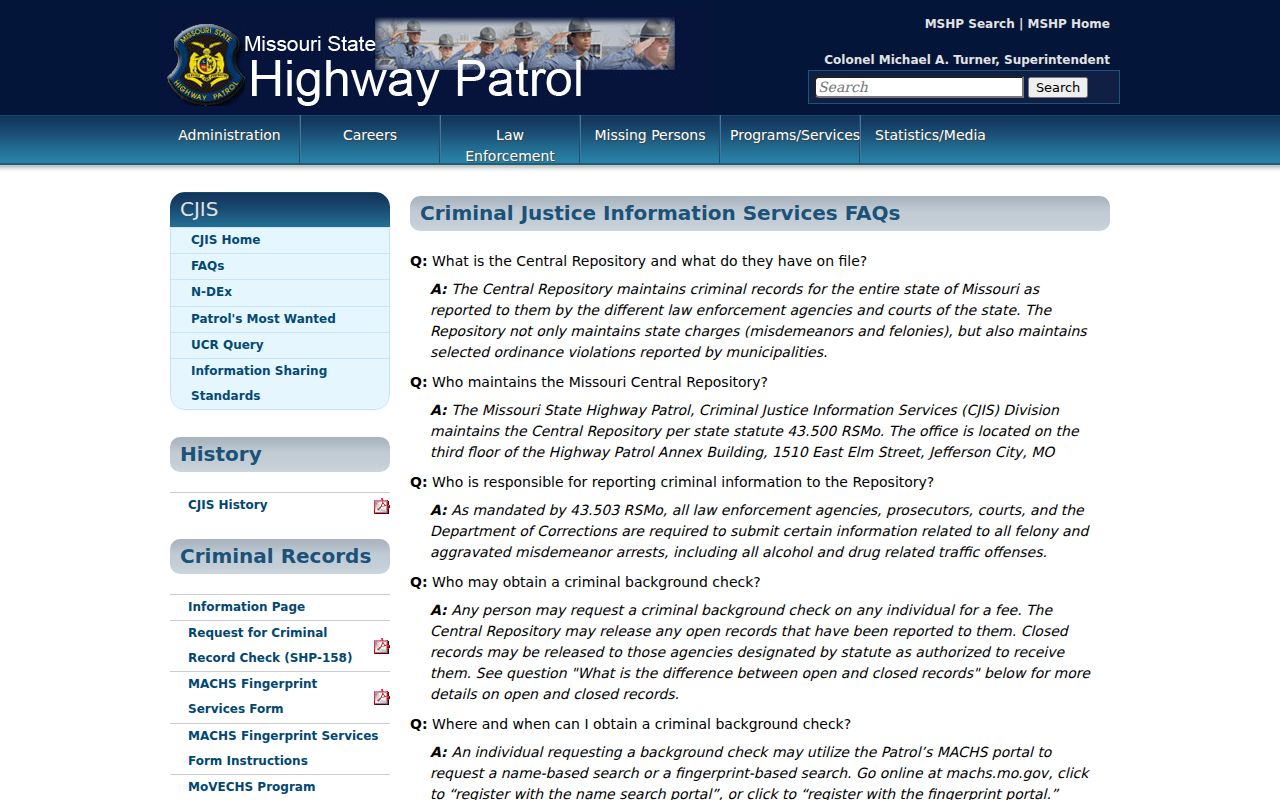
For Missouri warrant questions, the public FAQ points to local police. It keeps a criminal-history check and a warrant check distinct, so it helps route a personal inquiry rather than settle it. Note: The July 2026 change covers the unreturned arrest-warrant record set in Rule 4.24, not every court record statewide.
How Warrants Get Served in Missouri
A warrant directs an authorized officer to act. The clerk does not execute it. For felony process, §544.080 addresses directing a warrant to the sheriff in the county where the case is filed, subject to the prosecutor's direction. §544.090 gives judicial warrants statewide execution authority under the relevant article. The officer on the door could be a sheriff's deputy, a municipal officer, or another authorized peace officer. It depends on the order and the agency assignment. Missouri's county lines do not confine service of a felony warrant. Even so, do not assume every local warrant lands in every law-enforcement system or gets the same distribution. Section 57.100 describes sheriff duties to apprehend and execute lawful process, while municipal warrants in Missouri can run through a separate city police or marshal route. If service happens, booking, an initial appearance, and a release decision may follow. The issuing court's record still controls the case. Its clerk can identify the agency serving a particular order, which is why Missouri callers do best asking the court first.
Missouri Arrest Warrant or Felony Summons
A felony summons and an arrest warrant are different doors into a Missouri court. Rule 22.04 directs the court to issue a summons after a complaint shows probable cause. One exception applies. If the judge finds reasonable grounds that the defendant will not appear, or poses a danger, a warrant may issue instead. That call belongs to the court, case by case. Never assume a filed complaint means a Missouri arrest warrant has issued, or that a summons is a warrant under another name. The two instruments do different work. A summons tells the person when and where to appear. A warrant tells an officer to bring the person before the court. A Missouri bench warrant usually comes later, after someone misses a court obligation in an existing case. The difference shapes what to do next. Follow a summons date. Confirm an arrest warrant with the issuing court. Ask about recall of a bench warrant. A court clerk can identify which instrument sits in the file, and the Bench Warrant Lookup page walks through the missed-appearance process in Missouri.
| Process | Why it is used | What it directs |
|---|---|---|
| Felony summons | Judge selects appearance by summons under Rule 22.04 | Person to appear at the stated court event |
| Arrest warrant | Judicial process based on the complaint and rule conditions | Authorized officer to take the accused before court |
| Bench warrant | Later failure to appear or another court-process issue | Return the person to the court handling the case |
Missouri MULES and NCIC Warrant Access
Missouri's law-enforcement information systems are not public warrant portals. The Missouri State Highway Patrol's Criminal Justice Information Services Division runs MULES, the Missouri Uniform Law Enforcement System, along with the criminal-history repository. Authorized officers can use MULES for justice purposes, and FBI NCIC when eligible. The MSHP role under §43.509 creates no public self-search right. The 2026 CJIS-NCJ policy manual describes controlled, agency-authorized use only. A public criminal-history request is a different animal from a warrant check. It reports criminal-history information under that process. It does not certify whether an arrest warrant is active. The MSHP FAQ sends warrant questions to local police, while the issuing court holds the judicial order and current case status. Do not chase MULES or NCIC access through an unofficial service. Do not read a missing criminal-history entry as proof that no court warrant exists. Ask the Missouri court and the agency what they can confirm for the person concerned.
- Probable cause
- Facts supporting the judge's required finding for process.
- Complaint
- A charging document that states an accusation and may support a warrant request.
- Return
- The officer's report or court filing after execution or other disposition of a warrant.
- Recall
- A court action that withdraws its warrant.
- NCIC
- The FBI's restricted National Crime Information Center system, queried by authorized agencies.
Arrest Warrants, Summonses, and Bench Warrants
Missouri courts use several distinct orders, and the differences matter. Missouri judges sign all three. An arrest warrant starts custody on a criminal accusation. A summons just tells a person to appear. A bench warrant usually follows a missed court obligation. Both kinds can lead to arrest in Missouri. Yet the question behind each order differs. Under Rule 4.24, a search result may show the charge or case without revealing the warrant itself, so ask the issuing division which process was entered, what the judge ordered, and whether a later return or recall exists. A search warrant is a separate animal. It authorizes a search for evidence or property, not an arrest of the reader. Missouri's RSMo §542.276 sets procedures for an application supported by facts under oath. Court rules can keep that Missouri application confidential until return or expiration. A search-warrant filing is not an arrest warrant record. Nor should you assume a public Missouri index exposes either type in full.
| Record type | What prompts it | What the order does |
|---|---|---|
| Arrest warrant | Criminal complaint and judicial findings | Directs an officer to take the accused before court |
| Summons | Judge chooses appearance process | Sets a court appearance without directing immediate arrest |
| Bench warrant | Missed date or another court-process violation | Directs return to the court in an existing matter |
| Search warrant | Application and probable-cause facts about a search | Authorizes a defined search; it is not an arrest order |
After a Missouri Warrant Arrest
Once a Missouri arrest warrant is served, the court order and the case control what happens next. Booking comes first. Then the person goes before a judge. Release conditions get considered there. Under Rule 33.01 and §544.455, a judge sets conditions under the applicable law. A Missouri bond can secure release while the case stays open. But a bond is neither a fine nor a plea. Ask the Missouri court about the bond type and amount. Ask where it may be posted. Ask for the next required court date. Keep the order and payment receipt. If release depends on conditions, learn what each one requires and how to report compliance. Skipping court after release can bring added consequences under §544.665. Warrants can linger after an arrest, so ask when the record shows the warrant returned and whether any case obligation remains. The court can also explain whether counsel, a motion, or another hearing is needed.
Handling an Arrest Warrant in Your Name
Start with official channels if a Missouri arrest warrant might concern you or a family member. Gather a citation, court notice, case number, and any papers already received. Use Case.net to locate public case information, then call the issuing circuit or municipal division. Ask how an authorized person can confirm a warrant's status. Some unreturned arrest-warrant files stay confidential. A blank online result does not settle the question. A Missouri clerk can explain how to proceed when a public search shows nothing. Keep asking. Should a lawyer contact the court before any appearance? Ask whether the court will arrange a date or a surrender, what bond terms apply, and which agency is assigned to serve the warrant. A Missouri sheriff or police department may set its own confirmation policy. So follow the court's referral. A phone call or walk-in will not work everywhere. Use Browse Counties to find the county or independent-city page for the issuing court and its local service agency. A federal case needs the right federal court or counsel. No Missouri county clerk can clear a federal warrant.
Important: An arrest warrant can lead to custody when served. Confirm the issuing court and seek legal advice about a safe, court-approved way to appear and address release terms.
Note: In Missouri, surrender, bond, and appearance instructions vary by locality, so get directions from the issuing court and keep any written order.