
How Missouri Runs Its Most Wanted List
The Missouri State Highway Patrol runs Patrol's Most Wanted as an official public program. Individual agencies contribute profiles of selected fugitives. It is a communication channel, not a warrant database. There is no searchable roster of every Missouri warrant, court, or county. No query form exists. The program makes no complete-search promise and publishes no statewide reward rule or update schedule. The official MSHP site map is the route to the program, and it shows where the Most Wanted material sits within the Patrol's site. Treat it as a starting point.
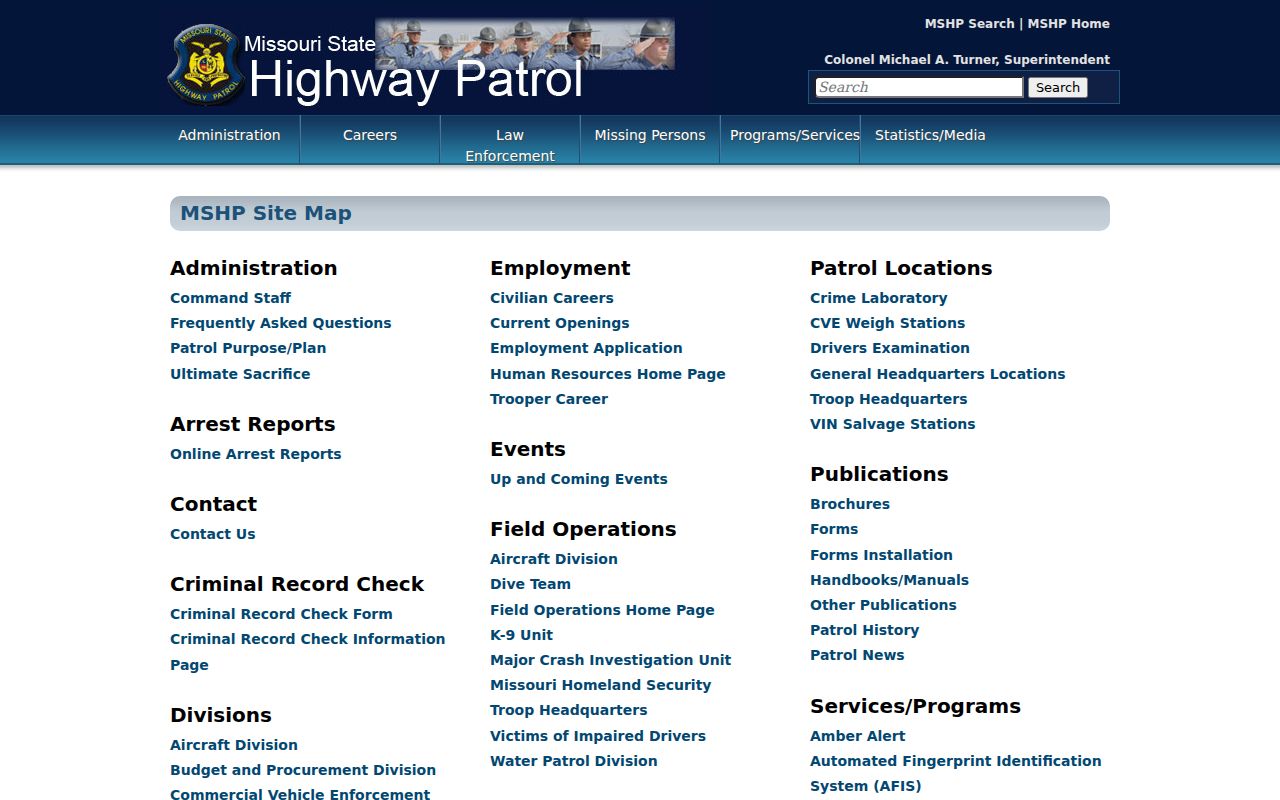
This official Missouri State Highway Patrol navigation page shows where the Most Wanted section sits, not any wanted-person profile or list of fugitive names.
Missouri State Highway Patrol
MSHP’s site map identifies Patrol’s Most Wanted as an official fugitive program. Use the agency’s current public route for program information; do not treat it as a complete warrant search.
Missouri Fugitive Coordination Has a Separate Role
Missouri coordinates fugitive work separately from any public list. Executive Order 25-02 created Operation Relentless Pursuit in January 2025. ORP links the Department of Public Safety, MSHP, the Missouri Information Analysis Center, sheriffs, municipal agencies, and U.S. Marshals partners. Nine MSHP investigator liaisons work with local partners. It supports field operations. It is not a warrant portal. Nor is it a most-wanted roster or amnesty program. The state reported 1,585 arrests or assisted arrests and 2,699 warrants cleared across 83 counties plus St. Louis City through April 6, 2026. Those totals cover ORP's first year. They are not a count of active Missouri warrants. An earlier official estimate of more than 17,600 active felony warrants was dated January 2025, and it is not a current register count. The Missouri Department of Public Safety's ORP overview describes the statewide coordination effort. Note: ORP activity totals measure one initiative's work during stated dates, not statewide active-warrant coverage.
Statewide or County Most Wanted in Missouri
Missouri offers two public layers. Neither is a complete active-warrant list. MSHP's Patrol's Most Wanted is a curated state program, while county sheriffs may post local wanted information on their own official sites with coverage that varies widely. The state sets no common county page format and requires no single public roster.
| Feature | Statewide List | County List |
|---|---|---|
| Run by | Missouri State Highway Patrol for Patrol’s Most Wanted | Each sheriff or local agency that publishes a page |
| Scope | Selected public fugitive profiles | Local material; scope and current availability vary |
| Search features | No statewide query form or complete coverage promise confirmed | No common statewide fields, update schedule, or search feature |
| Reward terms | No blanket statewide rule confirmed | Any local terms must be checked on the official page |
| Route | MSHP’s official program route | The local sheriff through Browse Counties |
A Missouri county page can be down, limited to one unit, or updated on a schedule nobody publishes. Availability varies by agency. Open the county or independent-city entry in Browse Counties to reach its official sheriff or police information. Follow the agency's own instructions. Confirm any court matter with the issuing division.
Missouri Has No Public Statewide Warrant List
Missouri's public sources answer different questions. None is exhaustive. Case.net can show eligible court case information. It is not a complete warrant-status search. A case may be confidential or not yet visible, and a public entry may not say whether a warrant remains active. MSHP and federal fugitive programs are selected publication channels, not Missouri court indexes. Effective July 1, 2026, Missouri Court Operating Rule 4.24 makes arrest warrants, probable-cause affidavits, and associated initial case records confidential until the arrest warrant is returned. That rule limits what a search can reveal. It does not erase the order. Authorized agencies still handle it. For your own case, call the issuing court. Ask the agency responsible for service as well. Note: A blank Missouri Case.net search or absent fugitive profile is not proof that no warrant exists.
Sending a Missouri Tip Safely
Send a tip through the official channel the responsible agency names. MSHP's public program route points to individual material. The state posts no general statewide tip line. Anonymity terms and rewards are left to each agency. Do not trust a contact detail copied from an unofficial repost, and never assume a reward applies to every Missouri case.
- Identify whether the information is on a Missouri state, county, or federal agency page.
- Use only the tip or contact route on that agency’s official page and read its current instructions.
- For a federal fugitive matter, use the U.S. Marshals Service tip-submission channel or the official district contact route.
- Do not approach, follow, or try to detain anyone; leave enforcement to the responsible officers.
Key point: For a Missouri tip, follow the responsible agency's official instructions. The state confirms no universal MSHP tip line, anonymity promise, or reward rule.
Federal tip routes sit apart from any Missouri court-status check. A tip passes information to an agency; it does not confirm an active warrant or clear a case.
Federal Fugitive Channels in Missouri Differ
Missouri sits split between two federal districts, Eastern and Western, of the U.S. District Court. The U.S. Marshals Service serves federal warrants there and backs fugitive investigations. Its Eastern District public page lists a Metropolitan Fugitive Task Force plus general contact options. The Western District's fugitive page posts no fugitive information. That silence is just how the public channel stands. It is not proof the district holds no federal warrants. Missouri defendants should go through the district handling the case, by the official Eastern District or Western District route. Neither page amounts to a full warrant search. The Marshals' 15 Most Wanted program is another curated subset rather than a complete federal or Missouri list. Note: A task-force or fugitive page supplements the court and service channels. It never replaces them.
Missouri Most Wanted or Active Warrant
A Missouri active warrant is a court order. A most-wanted profile is different in kind. It is a hand-picked public notice an agency posts to gather tips on certain fugitives. Neither one covers the other. Someone can hold a warrant and never appear on a state, county, or federal profile, and a profile never substitutes for the issuing court's live status. Checking an active Missouri warrant means one thing above all. Find a public case lead when one exists, then call the issuing division and the agency assigned to serve the papers. The county or independent-city route runs through Browse Counties. For the local warrant-check process spelled out, see Active Warrant Search. An empty profile page is never a clearance.
Missouri Has No Blanket Most-Wanted Reward
Missouri sets no blanket most-wanted reward. There is no statewide tip reference system or standard anonymity promise either. A reward may attach to one profile or a partner program. Check the current official agency page for that detail. Carrying a reward amount or tip condition from one case to another invites error. MSHP's program page and the U.S. Marshals Service's fugitive materials describe separate channels, so follow the published instructions for whichever program you use and only the contact details it lists. Missouri's Operation Relentless Pursuit stands apart as well. It coordinates law-enforcement activity. It is not an amnesty window, tip database, or public warrant portal. Note: No public Missouri source sets one reward amount or tip rule covering every state and county fugitive notice.
Finding Your Own Name on a Missouri List
Spotting your own name on a Missouri or federal fugitive notice calls for care. Treat a profile as a lead, not the record of your case. Reach a Missouri criminal-defense attorney, or the issuing court through a verified official channel. An attorney can ask the court to confirm the warrant's status and advise whether an appearance, surrender, or other step fits. A relative helping out should keep the inquiry on that person's own case and follow official court or agency instructions.
Important: A Missouri most-wanted profile does not tell you the court’s current status. Seek legal advice and contact the issuing court or service agency through verified official channels.
Use Browse Counties to reach the local Missouri court or sheriff route once the issuing jurisdiction is known. Ask the clerk what step the court requires, and ask the service agency how it confirms a court update. A relative can gather the citation or case number, but the issuing division controls its own record and what comes next.
Missouri Profiles Can Disappear
A fugitive notice and the court's warrant order are separate records in Missouri. An agency may pull a profile from public view. That alone does not recall, quash, or satisfy the warrant. The issuing court controls the judicial action, and the service agency needs the court's notice before updating its operational record. Missouri's official program material publishes no statewide profile-removal schedule and makes no synchronization promise. For your own case, ask the issuing clerk whether the court entered a recall or other order and how to get written confirmation. Then check with the agency assigned to serve the warrant. Ask whether it received the update. Case.net can supply an eligible case lead, though its public display does not certify a warrant's active status. That is why vanishing from a state or county page should never pass for legal clearance. Note: A publication change touches the notice only. Court and service-agency confirmation answers the status question.