
How Municipal Warrants Work in Missouri
A Missouri municipal warrant grows out of a case in a city's municipal division, the docket that hears ordinance and traffic matters. Miss a required appearance, or trigger another rule-based ground, and a judge can issue one. Courts call it a municipal warrant, a bench warrant, an FTA warrant, or a capias, so the label alone tells you nothing about what to do next. Missouri runs one unified circuit court structure, yet your citation still points to one specific municipal division. That matters. The warrant is managed by the court that issued it and the agency assigned to serve it, and it does not automatically become a county sheriff record. Missouri also has no public statewide active-warrant search that replaces the city court. So a person checking a Missouri municipal court warrant should start with the citation, notice, or city named in the case and work from there.
Missouri Municipal Divisions Sit Within Circuit Courts
In Missouri, "municipal court" is a division of a circuit court, not a separate statewide tier. Section 479.020 puts the municipal division inside that circuit structure, and the Circuit Court of Missouri is organized into 46 judicial circuits with municipal matters handled locally within the framework. Calendars, clerks, online instructions, and payment options can all differ from one city to the next. That is why a county search may not answer a city-ticket question. The city's municipal division keeps its own ordinance and traffic docket, while an associate circuit division handles other limited-jurisdiction matters, and both sit within the circuit court, so a reader still needs the correct division. Missouri's circuit clerk maintains circuit records, while municipal division staff run the local docket and coordinate with that clerk. When the public record is unclear, call the division named on the citation. Note: Missouri's unified court structure does not create one public municipal-warrant list or one uniform process for every city.
Municipal vs County Warrants in Missouri
A Missouri city warrant and a county-level warrant can involve different courts, dockets, and serving agencies. "County warrant" is not one record type either: the county case may sit in a circuit criminal or associate division, while the municipal case stays with the city division. For service, Section 479.100 describes routes for municipal process through a city marshal, a police officer, or the county sheriff where the law allows.
| Feature | Municipal Division | Circuit or Associate Division |
|---|---|---|
| Issuing court | The municipal division handling the city matter | The circuit or associate division handling the case |
| Common matters | City ordinance and traffic cases | Criminal and other matters within that division’s jurisdiction |
| Service route | City police, marshal, or county sheriff as directed | Sheriff or another authorized peace officer, as assigned |
| Public information | Local court case access; no complete public warrant index | Case.net may show eligible case information; it is not a warrant index |
What really separates them is the issuing division, not how a website labels the record. Missouri court case information can help you locate a docket. Still, neither Case.net nor a local public page guarantees current warrant status. Confirm with the court and the service agency actually responsible for the case.
Case.net Is Not a Missouri Warrant List
Missouri Case.net is the judiciary's public case-information portal. It can help you identify an eligible case, court, or division, but it is not an active-warrant database. A docket result may not show whether a warrant remains in force, and an empty search does not establish that no municipal warrant exists. The case could sit in a different division, be confidential, be recorded under another identifier, or simply not be visible yet. Local guidance makes the same point. St. Louis City's instructions explain how to find municipal cases through Case.net and warn that a recently issued citation may take several days to appear, which is routing help for that city rather than a statewide timing promise. Missouri residents should use the right circuit and municipal location, then ask the issuing clerk to confirm current warrant status. Note: a public docket can locate a case without showing the court's current warrant action or the service agency's latest update.
Missouri Municipal Warrant Checks
Start with the city and division named on the citation, summons, or court notice. A Missouri municipal-warrant check may take both a public case search and a direct call to the local clerk, since there is no statewide public warrant roster. Case.net search instructions differ by local court. The city clerk can identify the docket, explain what is public, and tell an authorized person how to ask about current warrant status.
- Use the city, citation number, court notice, and case date to identify the municipal division that handled the matter.
- If the matter is eligible for public access, search Case.net using the local instructions and select the correct circuit and municipal location.
- Open the relevant county or independent-city entry in Browse Counties to reach the local court and sheriff or police route.
- Ask the municipal clerk whether a warrant is active, what event or payment is required, and which officer or office handles service.
- Confirm any bond, recall, or appearance instructions with the court before relying on an online status or deciding how to proceed.
Missouri's municipal search paths are not uniform. Kansas City tells users that older matters may live in its legacy system, while St. Louis City's guide says a new citation can take several days to appear. Those details are exactly why a Case.net search alone may miss the right docket or the current status. The official St. Louis City municipal court search instructions lay out that city's Case.net route and its case-selection controls.
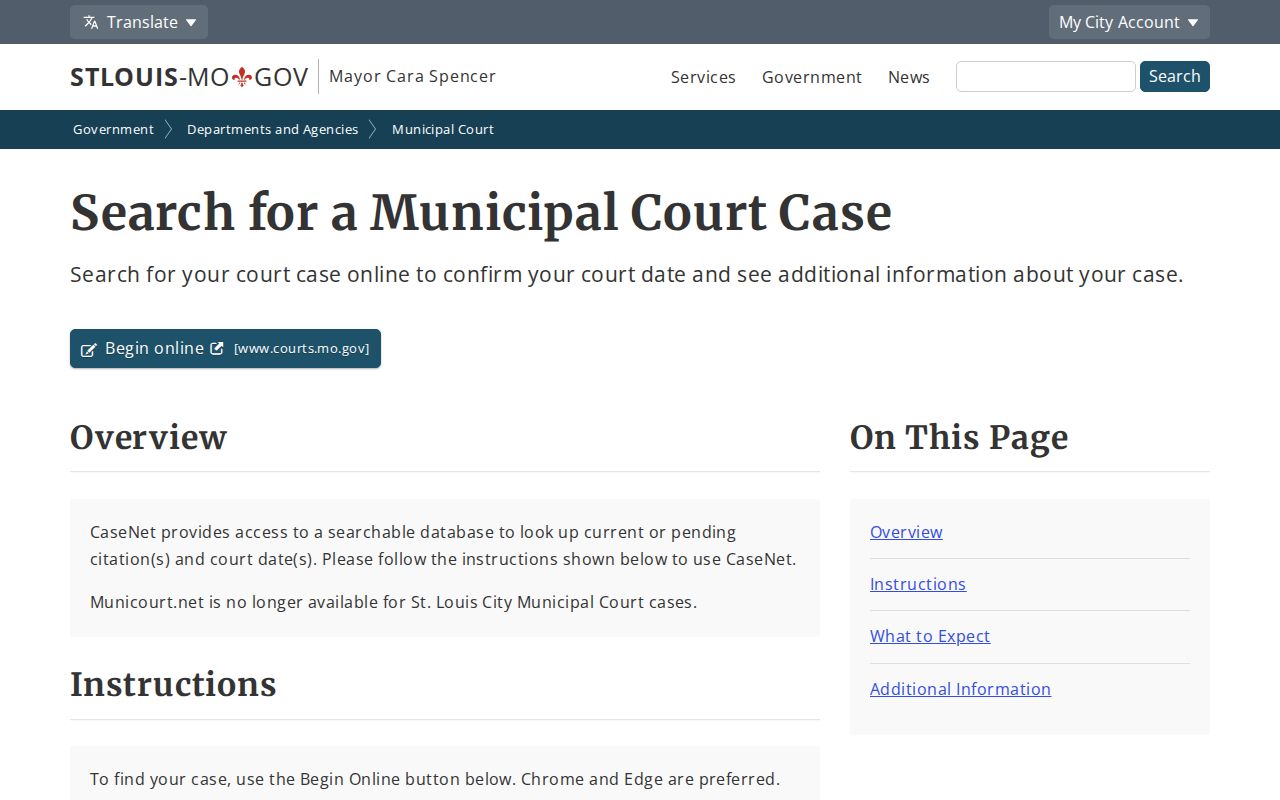
A Missouri municipal warrant check is a local case search, not a statewide warrant roster or a confirmed result.
Rule 37 Limits Missouri Municipal Warrants
Missouri keeps tight rules on when a city court may issue a municipal arrest warrant. Missouri Rule 37.43 sets two grounds. The court may doubt the defendant will appear if summoned. Or it may see evidence of danger to a victim, the community, or another person. Rule 37.45 then requires a judge's signature, aside from one narrow exception the rule itself allows. A missed payment alone is different. It does not automatically produce the same result in every Missouri municipal case. The standards also work in reverse. Once a case is resolved, or the grounds for the warrant disappear, the court must promptly recall or cancel the warrant and notify law enforcement. Timing can lag. The court's order and the serving agency's records may not update at the same moment, so ask the Missouri clerk whether the recall was sent and when to confirm with the officer responsible for service. Traffic cases get extra care. Section 479.360 grants prompt-hearing protections after an arrest on a municipal warrant. Deadlines differ for minor traffic and other violations. That does not bar every Missouri municipal traffic warrant. Note: Rule 37's municipal standards describe process and safeguards; the issuing judge and case facts still control each individual warrant.
Municipal Warrants: What They Show
Missouri sets no standard municipal-warrant screen that every city must publish. Fields vary by court. One local record may list a case identifier, the issuing division, the alleged offense, warrant type, date, status, return information, or a bond condition. Another may show less. Treat these terms as questions for the clerk, not a promise that a public warrant lookup will display each item.
| Warrant number | Not standardized A separate identifier may be assigned locally. No statewide format or accessible sample was verified. |
|---|---|
| Case and offense | The case number and alleged ordinance or traffic violation can help connect the process to the right docket. An allegation is not a conviction. |
| Issuing division | The municipal division and circuit identify which court issued the order and which clerk can explain access or resolution. |
| Bond or fine | A court may show case-specific release terms or an underlying balance. A fine, bond, and driver-record fee are different amounts. |
| Status or return | A local notation may report active, served, recalled, quashed, or cancelled status. Missouri has no statewide public status vocabulary or update promise. |
Read the case status and the warrant status separately. A warrant can be recalled while the ordinance case stays open. Even a payment may need more. A judge's order or a separate court appearance could still be required. If the record says "capias," ask the clerk what order it describes. Missouri statutes use that term, but local labels are not interchangeable across cases.
Missed a Missouri City-Court Date
A missed Missouri municipal court date starts with one task: find the exact case. Ask the issuing division what happened next. The court may have set a new date. It may have entered a default, issued a warrant, or routed a traffic matter through a separate driver-record process. The citation and docket history help the Missouri clerk locate the right record. A public result still cannot confirm whether a warrant is active. Kansas City's published instructions show one local example. Its municipal court describes a new date and summons after a first missed appearance. A later failure can lead to a bench warrant. Nonpayable matters require a court appearance. Other Missouri city courts may send different notices and follow different steps. Do not assume Kansas City's schedule or options apply elsewhere. Ask whether the division requires an in-person appearance, permits a new date, accepts a motion, or runs a warrant-review docket. Traffic citations raise a second question. Ask whether DOR has posted a FACT/NRVC suspension or Lieu of Bail hold. Those are driver-record actions, not proof of a Missouri warrant. The court and DOR may need separate compliance steps. Note: A missed municipal date calls for prompt contact with the issuing division; Missouri has no statewide reset calendar for city cases.
A Missouri Request Cannot Recall a Warrant
Kansas City Municipal Court publishes a warrant-review docket. People use it to ask for a new date or a recall review. The city's own guidance sets limits. The general docket is not an evidentiary hearing. It does not decide the underlying case, and it does not guarantee that the judge will recall a warrant. That distinction matters in Missouri. Asking to be heard is a request for court action, not proof the warrant is already cancelled. Kansas City also lists case-specific options for eligible matters. Payment, a payment plan, posting bond to a new date, or a recall-review request may each fit. The court does not issue warrants solely for failure to pay fines, its page says. These are Kansas City rules, not statewide ones. Another Missouri municipal division may differ. It may require a different motion, appearance, bond, or clerk contact. Check the current Kansas City Municipal Court warrant and bond instructions and its warrant-review docket guidance to see how that Missouri city runs the process. Note: A local review calendar does not create a Missouri-wide safe-surrender or amnesty program.
Clearing a Municipal Warrant in Missouri
Start with the Missouri municipal clerk. Ask whether the warrant is active and what the judge or court requires. The path in Missouri depends on the case. It may mean appearing, paying an eligible fine, arranging a payment plan, posting a court-set bond, or requesting recall. A payment alone may not close the case or transmit a recall order. Keep the receipt. Ask when the serving agency should reflect the update.
- Confirm the issuing municipal division, warrant status, and reason for the order with the clerk.
- Ask whether the judge requires an appearance, motion, new date, bond, or another court-approved step.
- Resolve the underlying matter under the court’s instructions and keep proof of payment, compliance, or the order.
- Ask whether the court sent a recall or cancellation notice to police, the marshal, or sheriff assigned to serve it.
- If DOR shows a traffic action, follow its separate process after the court provides the needed compliance or release document.
Caution: A municipal warrant does not automatically disappear with time. Confirm current status with the issuing court, then ask whether separate service-agency or DOR updates are required.
Missouri sets no statewide municipal-warrant counter, no fixed bond amount, and no standard recall form. Each court runs its own process. Use Browse Counties to find the county or independent-city site with the right court and service contacts. When a Missouri case looks serious or the steps feel unclear, an attorney can ask the court about a safe appearance or a recall request.