
Missouri Warrant Checks
Missouri offers no public statewide active-warrant search. Start instead with the Case.net case portal, which searches public court cases across the state. The case record you find narrows the next step. Match it to the court and place named on a citation or notice. A result is only a lead. It does not confirm that a warrant is still active, because the order and its status stay with the issuing court and the agency assigned to serve it. From there, a Missouri warrant check can touch several offices. The county sheriff, a city police or marshal office, and a circuit or municipal division clerk each hold a piece. Online sheriff lists differ from county to county. The statewide law-enforcement network is closed to public self-search. Keep the effort on your own record or a family member you are helping, and ask the issuing court how to confirm current status.
- Search Case.net by case number when it is available. If there is no number, use the public party-name route and select the right circuit and municipal location or case type where the local instructions require it.
- Open the county or independent-city entry in the Missouri county directory. Check whether its official sheriff page publishes a warrant list and whether the page is currently working.
- Contact the circuit clerk or municipal division clerk for the court named on the ticket or case. Ask if a warrant is active, which event or balance is involved, and what appearance or recall process applies.
- Confirm with the sheriff, police, or marshal assigned to serve the order. If no public list is available, ask the official records custodian about a narrow Missouri Sunshine Law request for releasable records.
- For a traffic matter, check any personal FACT/NRVC or Lieu of Bail action with the Department of Revenue separately. A license record does not say whether a court warrant exists; speak with a Missouri attorney about case-specific legal advice.
Missouri Warrant Checks Start with Case.net
Case.net is the judiciary's public portal for Missouri court cases. Use it to find an eligible case and the circuit or division behind it. It is not a warrant index. Protected filings stay hidden. Official Missouri municipal instructions describe the basic controls, a case-number search and a party-name route with a circuit selection and optional filters, though local options may differ. A citation number is often the clearest way in. With just a name, follow the party-name route. A new citation may take several days to appear. An older Missouri matter may sit in a local or archived system instead. A blank result points to the clerk, not to a conclusion about any warrant.
| Route / field | Type | Use | Limit |
|---|---|---|---|
| Case number | Text | Required for this search route | Ticket-number position varies by citation. |
| Last name | Text | Required in the St. Louis City local name-search guide | Partial matches and punctuation rules were not confirmed. |
| First name | Text | Optional in that local guide | Instructions may differ by court. |
| Date of birth | Date-like text | Optional in that local guide | MM/DD/YYYY format; do not place a person's full date of birth in public copy. |
| Circuit, location, case type | Selectors | Choose the jurisdiction and municipal filters where offered | Statewide options could not be inspected; choices vary by local instruction. |
The St. Louis City court search instructions cover the party-name controls and the related-case option. They show one route into Case.net. They are not a Missouri-wide warrant form. Follow the case to the responsible court clerk and service agency for a current warrant answer.
Missouri's Statewide Warrant System
Missouri has no public statewide active-warrant search. Several statewide services touch warrant-related records, yet each answers a different question. Missouri's warrant system spans a court portal for eligible public case information, a restricted law-enforcement network, a curated fugitive program, and separate driver-record actions for some traffic cases. None of them is a public registry. None can confirm every county warrant. Warrants begin in the court with the case. Missouri's circuit courts sit in 46 judicial circuits, with associate and municipal divisions handling many lower-court matters. The Circuit Clerk keeps the circuit records. A municipal division clerk or local court staff may run a city's docket instead. Service then falls to the county sheriff, municipal police, a marshal, or another authorized officer. The court and its assigned agency, not any statewide portal, confirm what the order's status is today.
| System | What it holds | Access and limit |
|---|---|---|
| Case.net | Eligible public court case information | Public case portal; not a warrant index. |
| MULES | Wanted-person and criminal-justice information used by authorized agencies | MSHP CJIS administered; no public self-search. |
| NCIC | National law-enforcement information | FBI and authorized agencies; not public. |
| FACT/NRVC and Lieu of Bail | Specified traffic-compliance and license actions | DOR driver records; neither is a warrant database. |
MULES Is Not Missouri's Warrant Search
The Missouri Uniform Law Enforcement System, known as MULES, is a criminal-justice network run by the Missouri State Highway Patrol's Criminal Justice Information Services Division. RSMo §43.509 gives the Patrol that administrative role. Authorized agencies enter and query wanted-person information through it. The public has no login. No lawful self-query route exists for a private person. MULES does not blanket every warrant type, court, city, or county in Missouri, and it publishes no complete warrant count or public refresh schedule. That matters when you are checking your own case. MSHP's public criminal-history service answers a different question. It is no substitute for a Missouri warrant check. The Patrol's CJIS FAQ sends outstanding-warrant questions to local police. The local Missouri court and its assigned service agency remain the confirmation points.
Access limit: MULES and FBI NCIC are restricted law-enforcement systems. A public Case.net result, criminal-history search, or curated profile cannot confirm whether every Missouri warrant is active.
Warrants in Missouri: The Main Types
The label and issuing order matter on a Missouri warrant record. An arrest warrant follows a criminal accusation and judicial process. A bench warrant follows a missed court date and brings a person back before the judge. Missouri statutes also use “capias,” and local offices may say “capias warrant,” though that label does not always mean a fine-collection order. A search warrant authorizes a search, not an arrest.
| Warrant type | How it arises | Who issues it |
|---|---|---|
| Felony arrest | Complaint and probable-cause process under §544.020 and Rule 22.04 | Judge in the court with the case |
| Bench / FTA | Missed appearance or another court-process violation | Judge in the circuit, associate, or municipal division |
| Capias / capias warrant | Context-specific process to bring a person before court | Issuing court; the exact order controls |
| Search warrant | Probable-cause request to search specified places or property | Judge under §542.276 |
| Fugitive process | Action on a warrant from another jurisdiction | Courts and agencies handling the originating matter |
Each type can carry different access rules, service paths, and ways to resolve the case. A traffic license flag is not another warrant type. Ask the issuing court what document was entered. A broad label on a local Missouri web page is not a reliable answer.
Missouri Municipal Warrants Stay in City Dockets
Missouri runs its city courts inside its circuit courts. Under §479.020, a municipal division belongs to the circuit, and the state has no separate justice-of-the-peace tier. That division can still keep a distinct traffic or ordinance docket, with its own staff and its own public instructions. Other limited-jurisdiction matters go to an associate division. So a sheriff roster or felony search may miss a skipped municipal appearance. The citation's court and division are the key clues. Municipal warrants may be directed to a city marshal, a police officer, or the county sheriff under §479.100. The local division clerk can identify the case path and what a person must do next. Rule 37 also requires prompt communication of a recall or cancellation once the matter is resolved or the grounds for the municipal warrant end. None of this creates one public statewide list. Missouri sets no single statewide bond rule either. For a city ticket, use the jurisdiction selector that court describes. If the result is absent or unclear, contact the issuing division. The county-level directory entry leads to local court and service routes without treating one city's procedure as the Missouri rule.
Missouri Warrant Records: What They Show
Missouri uses no common public format for warrant entries. One office shows little, while a fuller record may identify the case, the issuing division, the order, bond terms, service, and any later recall. A local site may publish only a short summary. A Missouri court file can contain documents subject to access rules. The terms below describe fields that may appear, not a promise that every office displays them.
| Warrant number | A local identifier, when the court or agency assigns one. No statewide sample format was confirmed. |
|---|---|
| Case number | The court's case identifier, which can help locate the public docket. |
| Charge or offense | The alleged matter behind the process; it is not a finding of guilt. |
| Issuing court | The circuit, associate, or municipal division that entered the order. |
| Bond terms | Case-specific release conditions, if any. There is no statewide fixed warrant bond. |
| Status or return | A local entry may show active, served, recalled, quashed, or satisfied; no statewide public status code set was found. |
Names can vary. A docket entry can also lag behind the event. The issuing clerk can explain which record is public and whether an officer has returned or updated the process, and the service agency can confirm its operational status. A blank field is not a final answer.
Missouri Warrant Status Terms Need Local Confirmation
Missouri courts use no single statewide list of status words. A term on a local page or in a clerk's reply only hints at what happened. The court docket and its order control. If a word looks off, ask the clerk what event it marks and what step, if any, remains.
- Active
- A local record may use this for an order not yet shown as served or recalled; confirm its current effect.
- Served
- An officer reports execution of the warrant. The underlying case can still be open.
- Recalled
- The court withdraws the warrant, often after compliance or a new court date.
- Quashed
- A court sets aside the order or process.
- Capias
- A court process directing an officer to bring a person in; context determines its purpose.
- FTA
- Failure to appear at a required court event. The result depends on the case and court rule.
Warrant Record Access Under Missouri Law
Missouri treats government records and court files differently. The Missouri Sunshine Law, Chapter 610, covers many public records held by state and local offices. Judicial case files are another matter. Supreme Court Operating Rules 2 and 4 govern access there, and investigative, juvenile, or sealed records can be withheld. A Sunshine request may get you releasable sheriff records. It still may not produce a warrant-status answer. Put any written request in careful shape. Name the custodian and describe the record, the office, the date range, and the format you want. Chapter 610 tells a Missouri public body to act as soon as possible, and no later than the end of the third business day, though a reasonable delay can push back production. Ask about charges first. When work or media costs may apply, request an estimate. For a court document, contact the circuit or municipal clerk about public remote access, a courthouse terminal, or any required authorization.
Missouri access rules:
RSMo §610.023 sets the public body's response window and requires an explanation when access is delayed.
RSMo §610.026 addresses copy and research charges, including a standard paper-copy ceiling and actual-cost rules for other work.
RSMo §211.321 protects juvenile court records subject to limited exceptions.
Missouri Warrant Access Changed in July 2026
Missouri Court Operating Rule 4.24 changed public visibility for unreturned arrest warrants on July 1, 2026. The change came through a Supreme Court order dated March 31, 2026. Under that order, an arrest warrant, its probable-cause affidavit, and associated initial case records stay confidential until the warrant is returned. Search-warrant applications also stay confidential until return or expiration under the applicable rule. The result reaches Case.net. A case may simply not appear while a Missouri warrant is outstanding. That does not cancel the order. It does not block an authorized court inquiry. A missing online case therefore has more than one possible cause: confidentiality, delay, an incorrect court selection, a municipal docket, a name variation, or another access limit. The right next step is to ask the issuing court how an authorized person can confirm status and what identification or process is needed. The effective date belongs to this one court-access rule. It should not be read as making every Missouri warrant, municipal record, or court matter confidential. The Supreme Court order describes the amendment. That order controls over any search result that looks incomplete.
Missouri Traffic Holds Are Not Warrants
A Missouri traffic ticket can spin off several records at once. Miss a court date and you may face court process, a Department of Revenue action, or both. FACT/NRVC covers certain failure-to-appear and nonresident-compact suspensions. A Lieu of Bail hold is different again: it can block a new or duplicate license without being a suspension, and without being a warrant. DOR's authenticated MyDMV channel and phone IVR line only work for your own driver record. Neither is a public name search. Three statutes shape when a suspension or a warrant can even enter the picture. For covered moving violations, §302.341 requires a court notice and a 30-day resolution sequence before DOR gets a suspension report. Section 544.045 takes a different route, tying a license to bail, and it allows a limited $50-per-offense bond option with exclusions. Section 307.018 is the narrowest of the three. It bars an arrest warrant for failure to answer certain Chapter 307 equipment infractions and sets out notices plus ability-to-pay options. Remember one thing, though: none of these rules erases a warrant a judge issued separately. The DOR FACT/NRVC FAQ spells out the costs. Covered reinstatement takes court compliance and a $20 fee. Removing a Lieu of Bail hold takes a court release order and carries no $20 reinstatement charge. Your court balance, any bond, the online convenience charge, and the DOR fee are separate amounts. Start with the ticket court in Missouri, then pull your DOR record if a license action is also in play.
Operation Relentless Pursuit Reports Missouri Warrant Activity
Operation Relentless Pursuit is a coordination effort, not a search tool the public can query. Executive Order 25-02 linked the Department of Public Safety, MSHP, the Missouri Information Analysis Center, county sheriffs, municipal agencies, and U.S. Marshals partners. Nine MSHP investigator liaisons cover the Patrol's troop regions. Their job is field coordination and information sharing. No public statewide warrant register comes out of it. The Governor's first-year report counted 1,585 arrests or assisted arrests and 2,699 warrants cleared through April 6, 2026, across 83 counties plus St. Louis City. Those numbers describe one program's activity over its coverage area. They are not a tally of every Missouri warrant, and not a live count of active cases. Earlier first-month totals were program-specific too. Keep the date and scope attached whenever you repeat them. A person with a case question still goes to the issuing court. The Missouri Department of Public Safety's program overview describes the partnership and what the state says this effort covers.
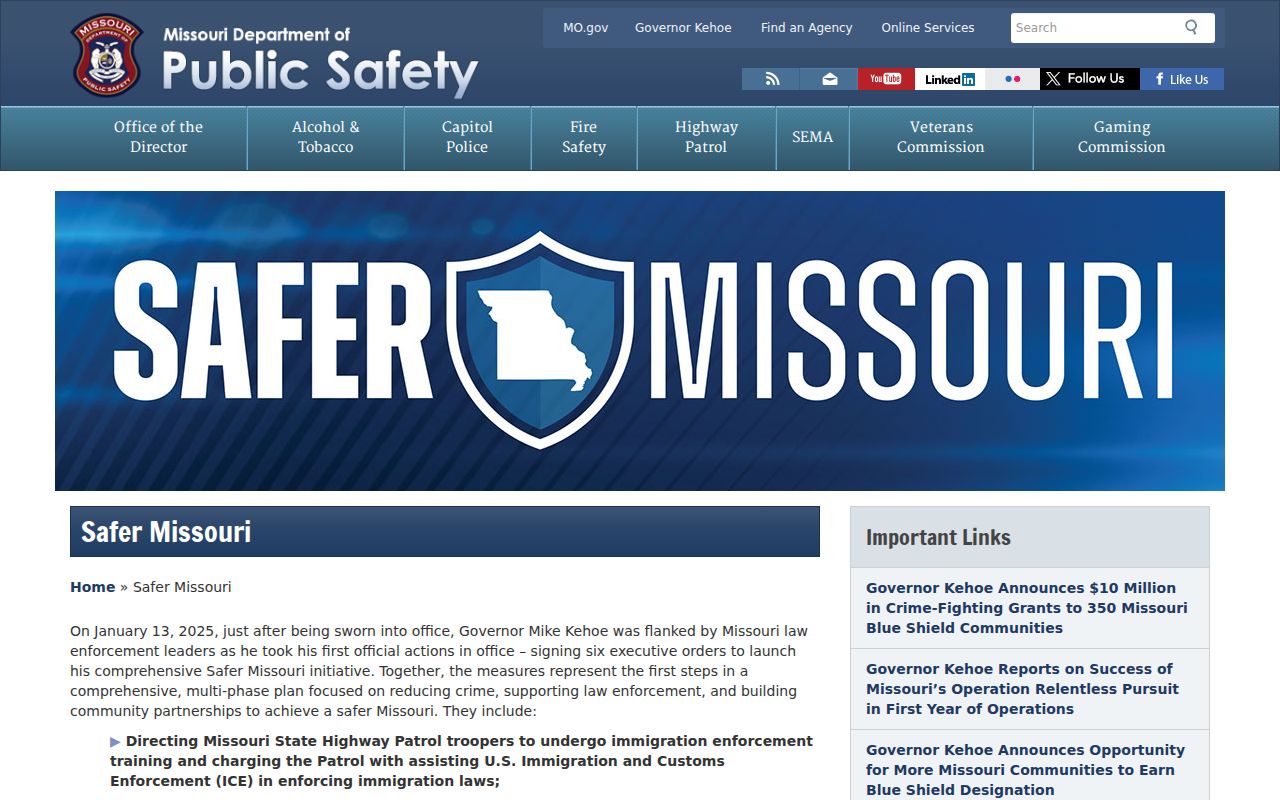
The overview describes enforcement coordination, not a public name lookup. Missouri offers no query box here. For a case question, contact the issuing court and the local agency that serves the warrant.
Resolve a Missouri Warrant
Missouri has no statewide warrant counter, universal recall form, bond schedule, or recurring amnesty window. Every path runs through local offices. Start with the court that issued the order. Then verify the court's instructions with the agency assigned to serve the warrant. Case.net can surface a public case, but even a protected or absent record does not stop a clerk from explaining the authorized path to the person involved.
- Gather a citation, notice, case number, and the relevant court or city. Ask the clerk whether the warrant remains active and what event caused it.
- Ask about the approved appearance, bond, payment, or motion-to-recall process. A lawyer can advise whether a voluntary appearance or motion is appropriate for the specific case.
- Confirm the location, hours, identification, and service-agency update steps directly with the court and sheriff or police. No statewide walk-in schedule or update deadline was located.
- Keep receipts and court orders. Posting bond can secure release but does not decide guilt or close the case; traffic compliance may also require a separate court notice to DOR.
Municipal Rule 37 standards direct the court to communicate a recall or cancellation promptly once a matter is resolved or its basis ends. Ask when the serving agency's record will catch up. Use the county directory to find the right Missouri court and service route. Bring in counsel for a serious, federal, out-of-state, or uncertain matter.
Missouri Has No Statewide Warrant Amnesty Window
Missouri has no statewide warrant-amnesty week, no recurring roundup, and no general fine-reduction program. Operation Relentless Pursuit exists to enforce and coordinate, not to forgive. Waiting for a statewide event that has never been announced is a bad plan. The issuing court alone controls recall, bond, payment, and a new appearance date. One dated local example shows why scope matters. After the May 16, 2025 tornado, St. Louis City Municipal Court paused issuing new failure-to-appear bench warrants, then announced that issuance would resume on August 4, 2025. The pause was temporary. It applied to new warrants in that one city, and it recalled nothing and changed no policy elsewhere in Missouri. The city's notice is history, not an open option. Local courts may run warrant-review dockets or payment plans. Eligibility and timing are local, so check the official court site or call the clerk before counting on either. The county directory points you to the proper division.
Warrant Records by County in Missouri
The warrant record lives at the local level. The issuing court and the serving agency hold it, and they explain the next step. Missouri's directory covers 115 county-level entries: 114 counties plus the independent City of St. Louis. Each link opens a local home page. Some jurisdictions publish an online warrant page. Others rely on a clerk or direct sheriff contact. A listed county page is not proof that every record sits online.
St. Louis County
Clayton · Largest county-level population in the state per 2025 estimate
Jackson County
Independence · Kansas City area; sheriff's unit coordinates fugitive intake
St. Charles County
St. Charles · St. Louis metro; county police are a task-force partner
Greene County
Springfield · Sheriff's linked public warrant search was unavailable during research
St. Louis City
Independent city · Municipal ticket guidance routes through Case.net
Clay County
Liberty · Kansas City metro; confirm the issuing circuit or city division
Open the directory of all 115 Missouri county-level entries to find a local route to the court and sheriff.